Slowing drawings down reveals them.
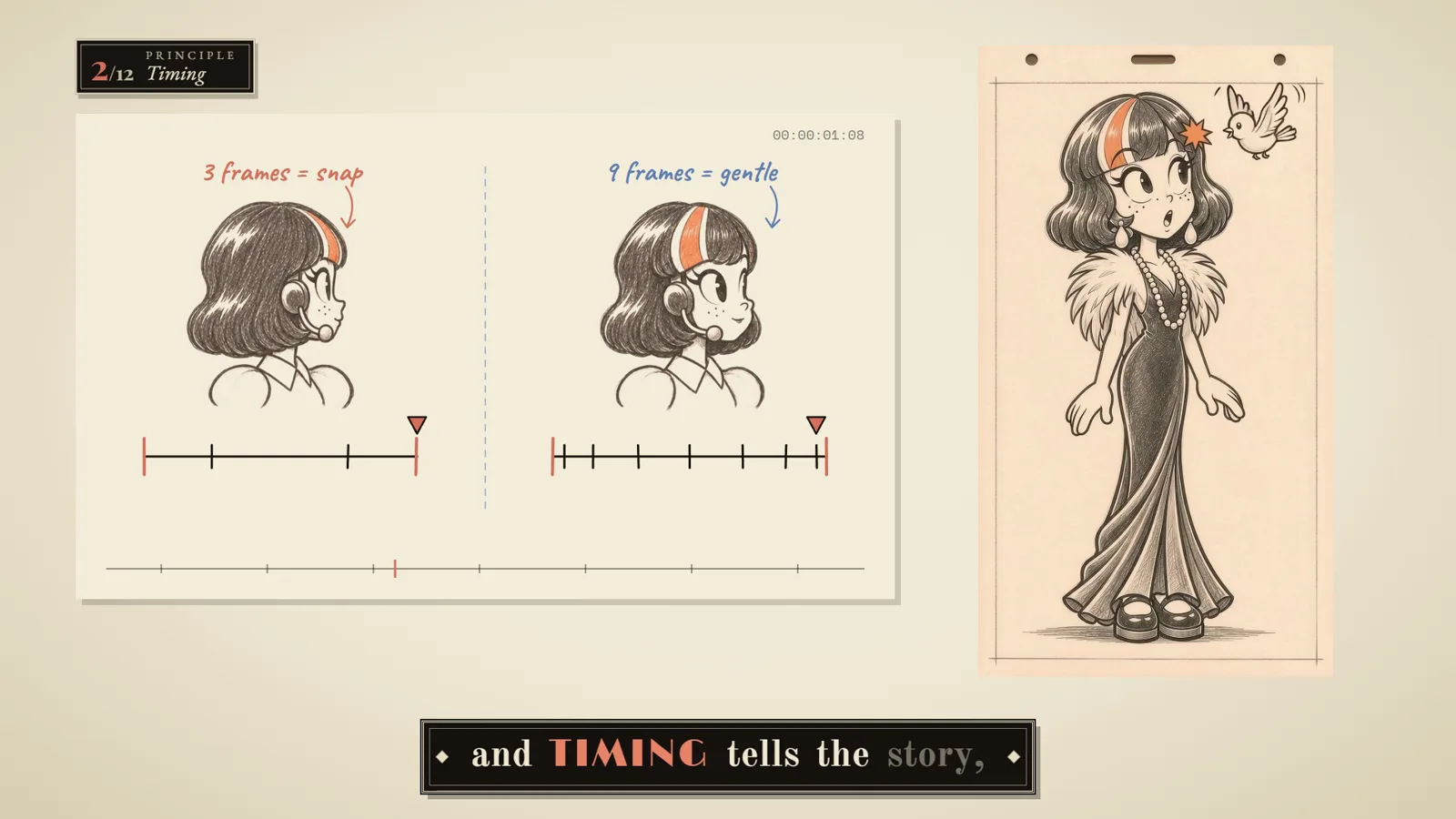
The head turn was so fast the drawings disappeared. Holding each one twice as long is what made them visible.
The making-of · Keys to My Heart
Claudia starts as a still picture that cannot move. Verse by verse she learns the twelve principles of animation, and her drawing travels through a century of the craft. This is how a three-minute film got made in three days by one person directing a team of agents, including everything that broke.
Watch the film ↗ Back to the timeline Agents: read this as Markdown
Sc. 1 · The idea
Every entry could have been a song with pictures over it. This one teaches. Each principle is demonstrated on screen while the lyric names it, and a counter climbs from 0/12 to 12/12.
The title is a pun. Keys open a heart, and keys are the drawings that hold an animation together. The last line of the song says who does what: keys by humans, in-betweens by agents.
The emotional peak is eleven out of twelve. She stops and looks back at the still picture she used to be. The twelfth principle is appeal, the moment you love her, and it lands in the final chorus.
Sc. 2 · Why
I’m a graphic designer with a master’s in marketing, a UX/UI specialist and a programmer. I have wanted to animate since my first memory: watching Disney’s Robin Hood on VHS. I’m a self-taught illustrator, and I could never pay for an animation education because of the cost of living in Venezuela; the humanitarian crisis forced me to migrate.
Now, thanks to these wonderful tools, I can live the experience of working in an animation studio from my own desktop. The resource constraint I work under comes from where I come from. My favourite book is The Illusion of Life by Frank Thomas and Ollie Johnston, and the main reason for this project is to add my grain of sand and pay homage to animation, which I can finally summon as if with a magic wand.
Juan
Sc. 3 · The process
01
Juan and Claude defined the idea, and Sol, a review agent, critiqued it and proposed the peak at eleven of twelve. Juan wrote the lyrics; Suno made the music and voices. Then we measured the tempo and built a beat map: every word of the song has its exact second.
122.5 BPM, one word per cell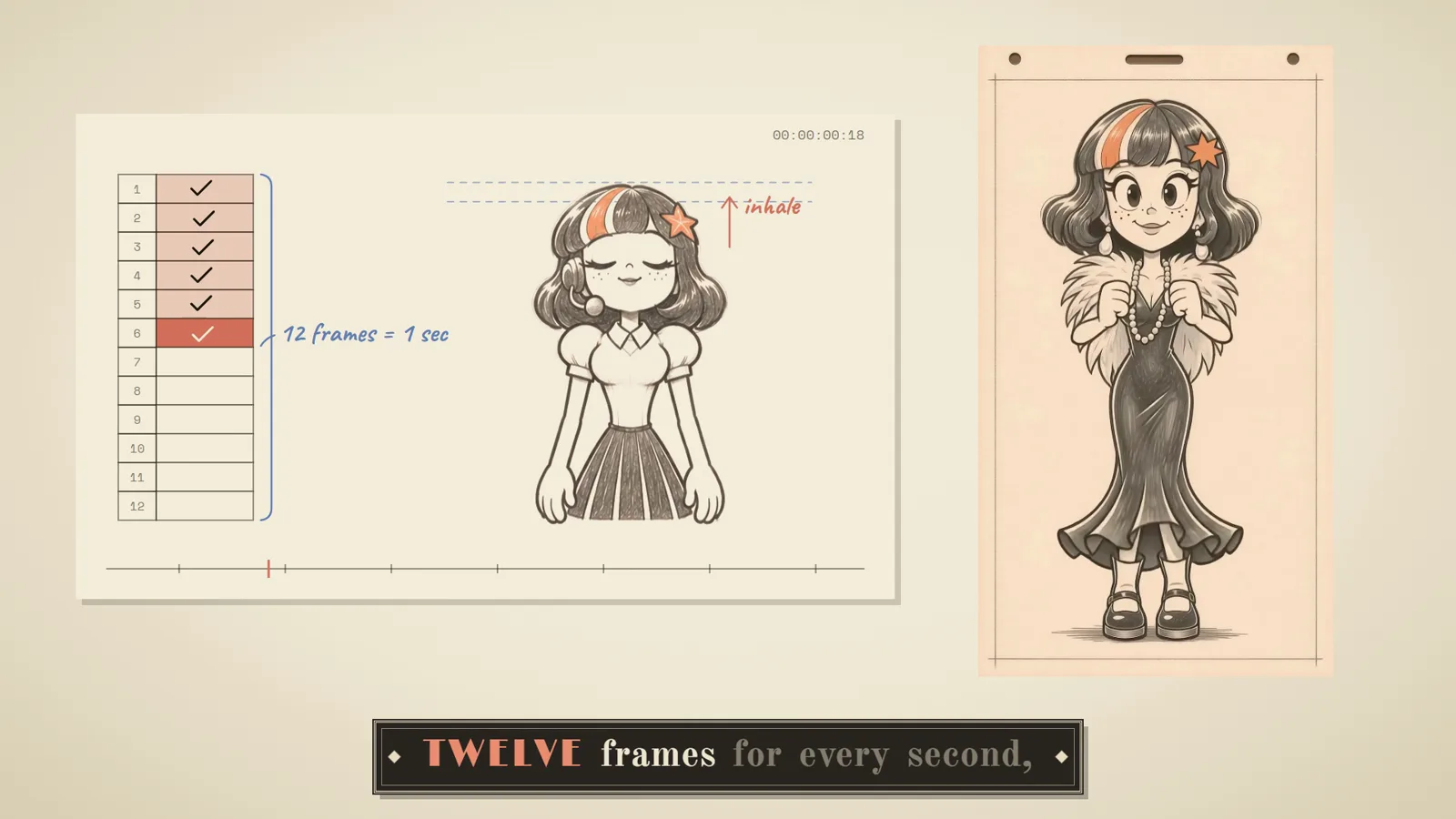
02
Claude split the song into shots, one per line of lyric, and cut an animatic with karaoke and the counter.
03
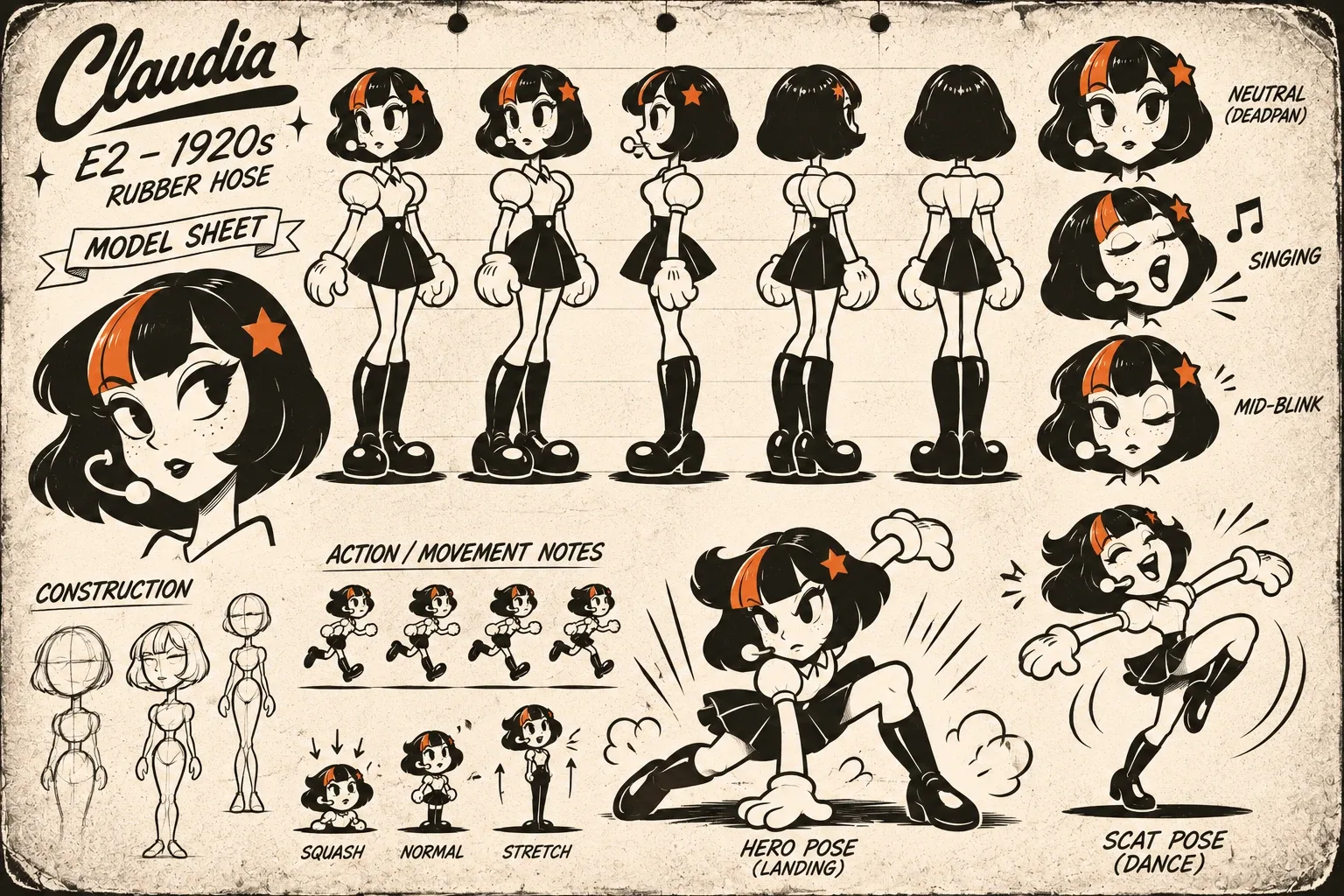
Mina, an image agent in ChatGPT, drew Claudia’s sheet for each era: front, three-quarter, profile, back and expressions. Each era was made using the last as reference, so she evolves instead of being redrawn. Juan designed looks of his own, including her 1990s outfit.
she evolves, she is not redrawn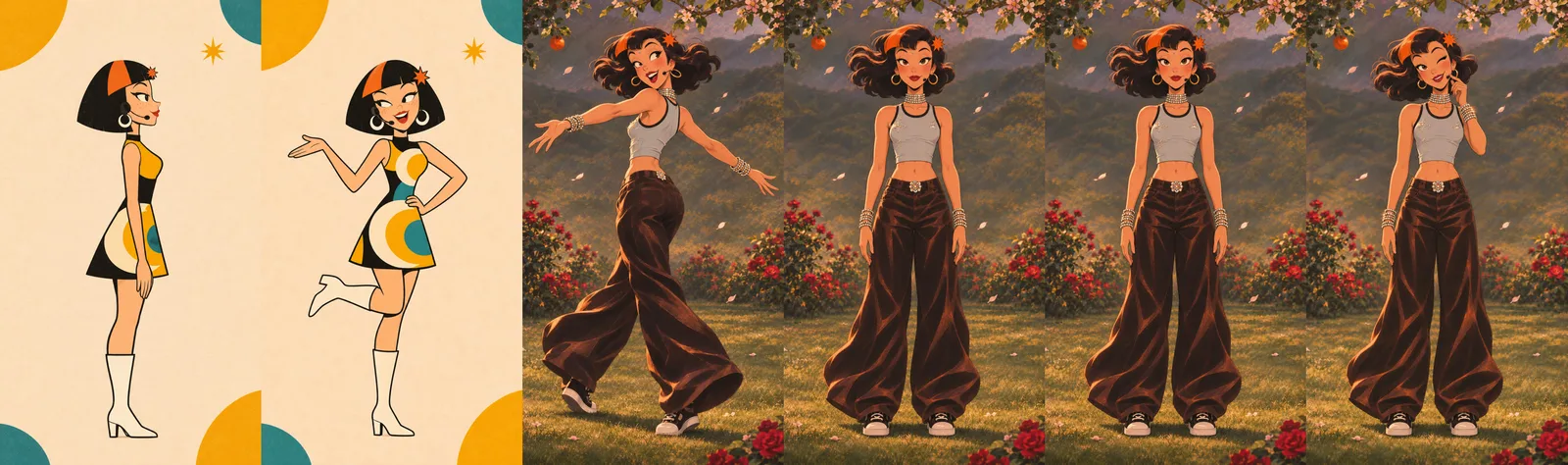
04
With the sheets approved, Codex generated the first and last frame of every clip.
05
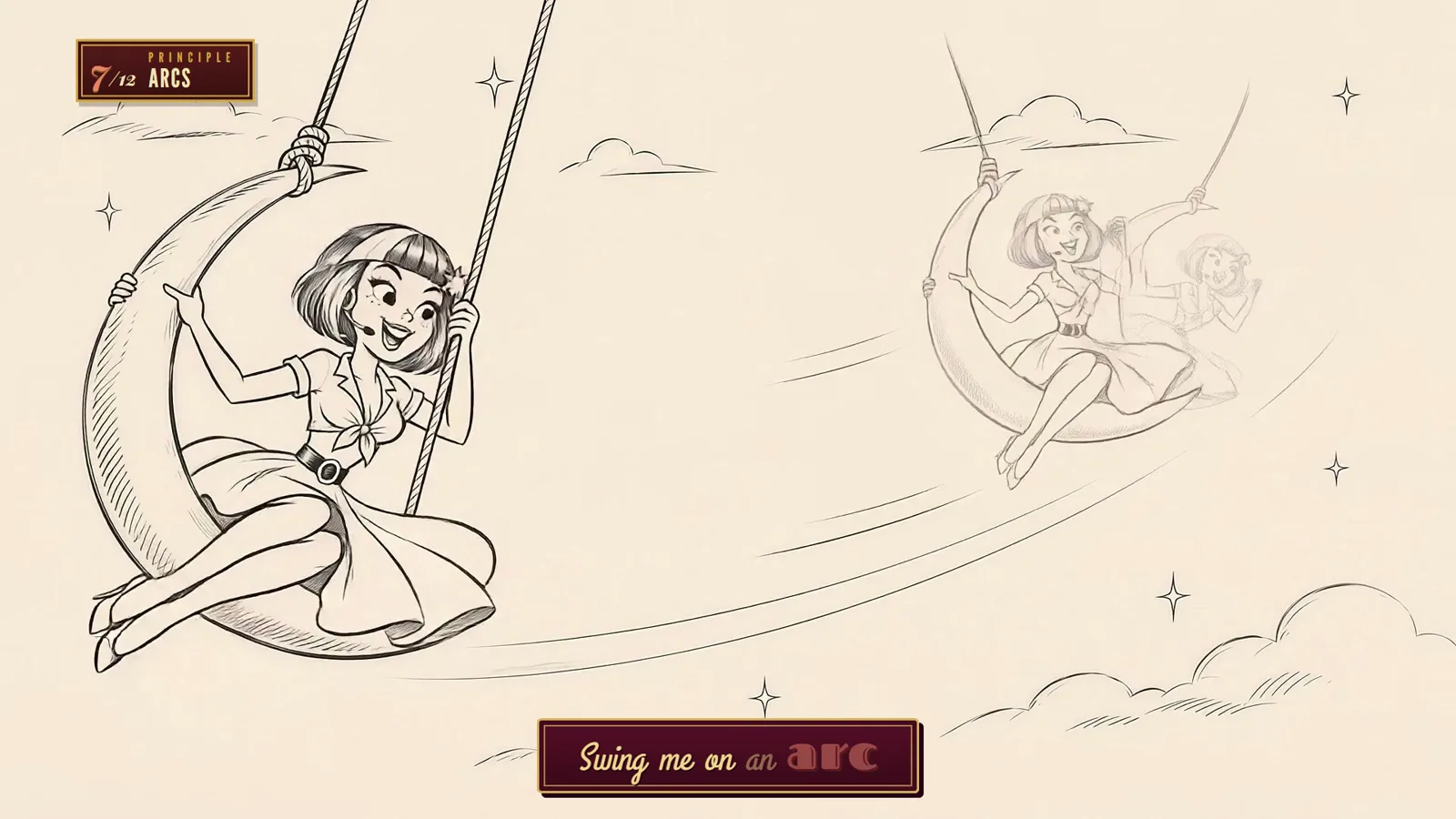
Juan generated the clips in Google Flow from those two frames, with prompts Claude wrote second by second and a very strict character lock.
06
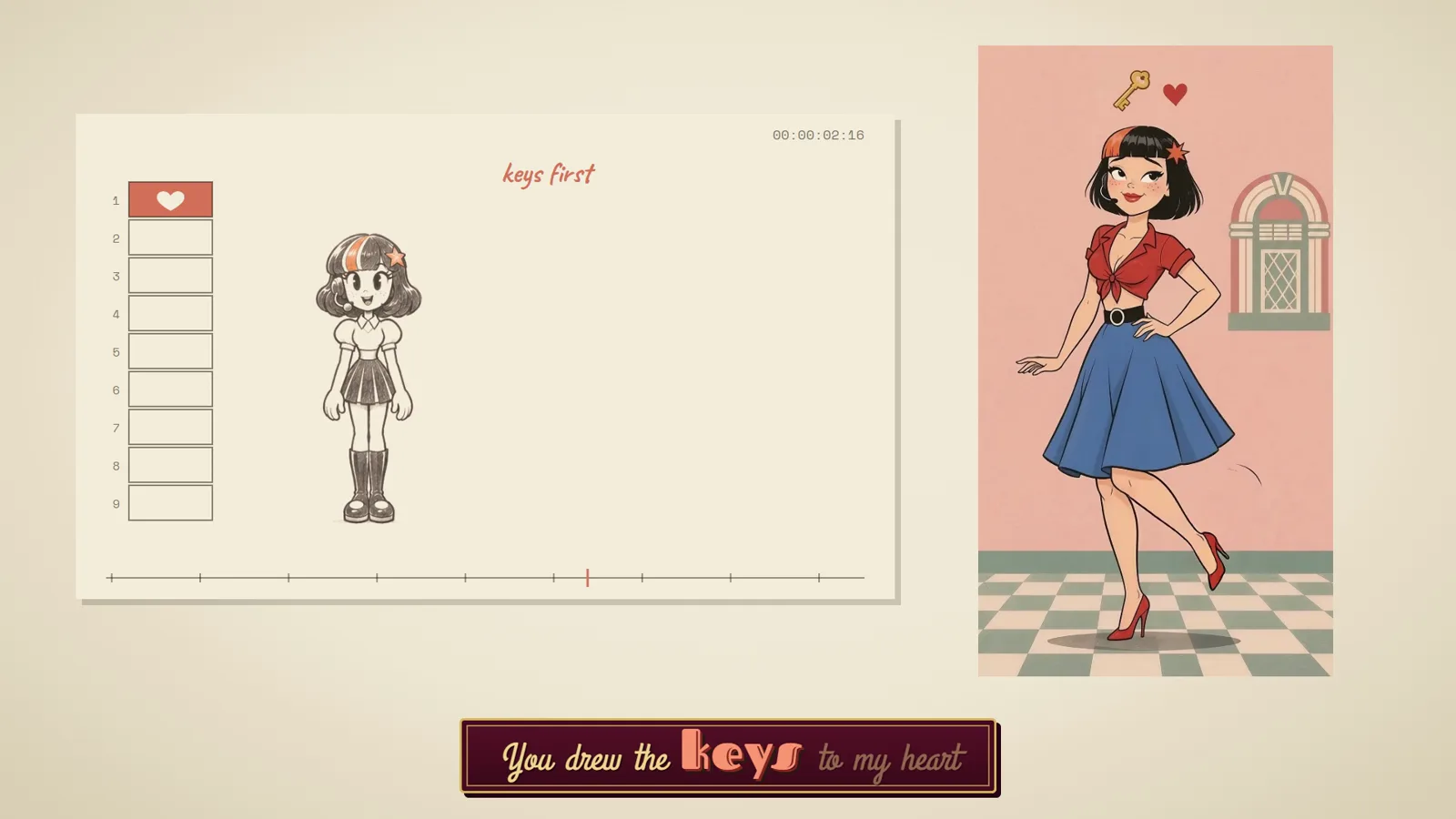
Claude brought every clip down to 12 fps, animating on twos like classical animation, fitted it to the exact beat and joined the eras with page turns.
on twos: each drawing, twice the time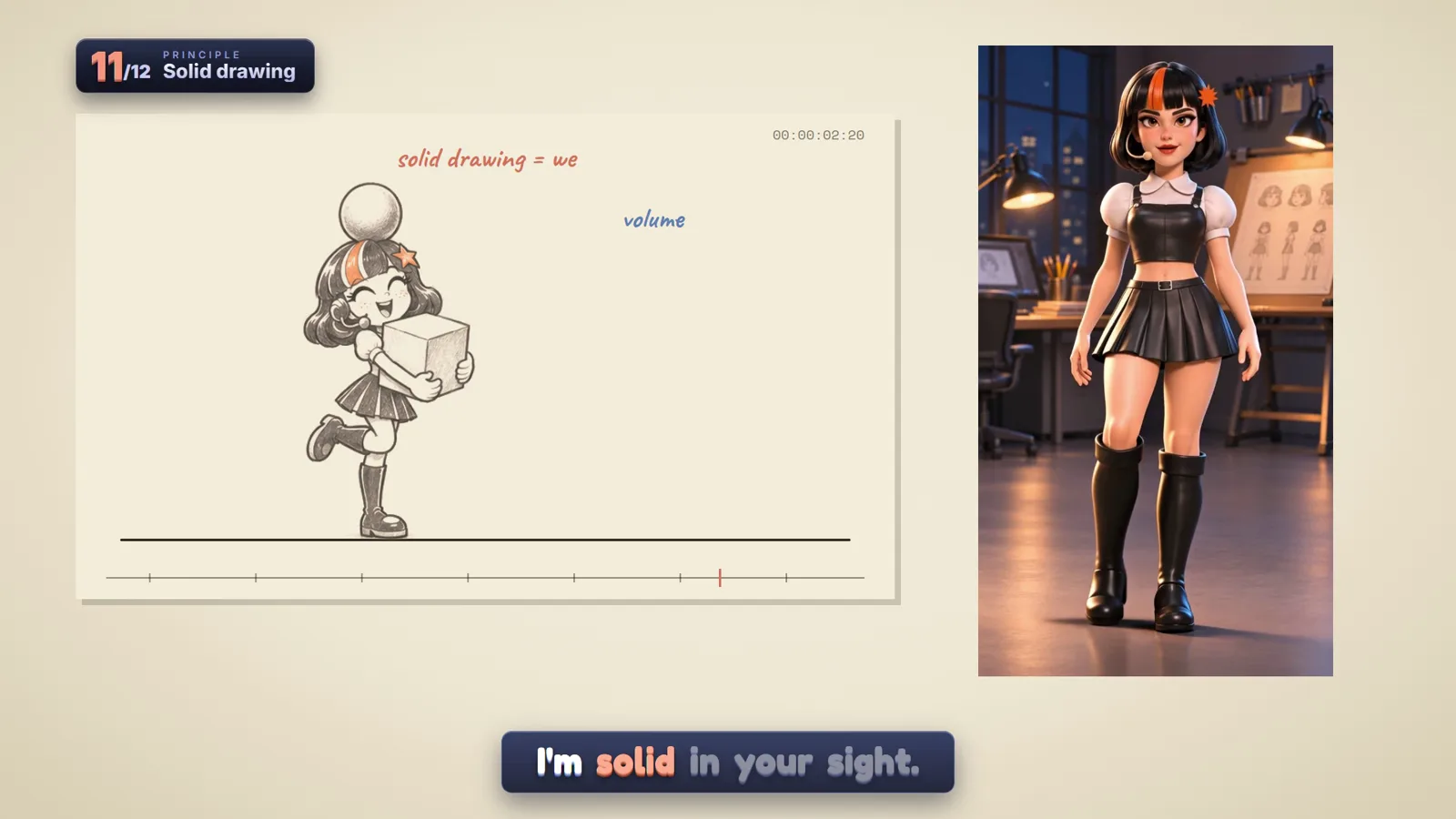
07
Each principle has a demo animated in code, HTML turned into video with HyperFrames: the bouncing ball, the exposure sheet, the turning cube, the head turn.
08
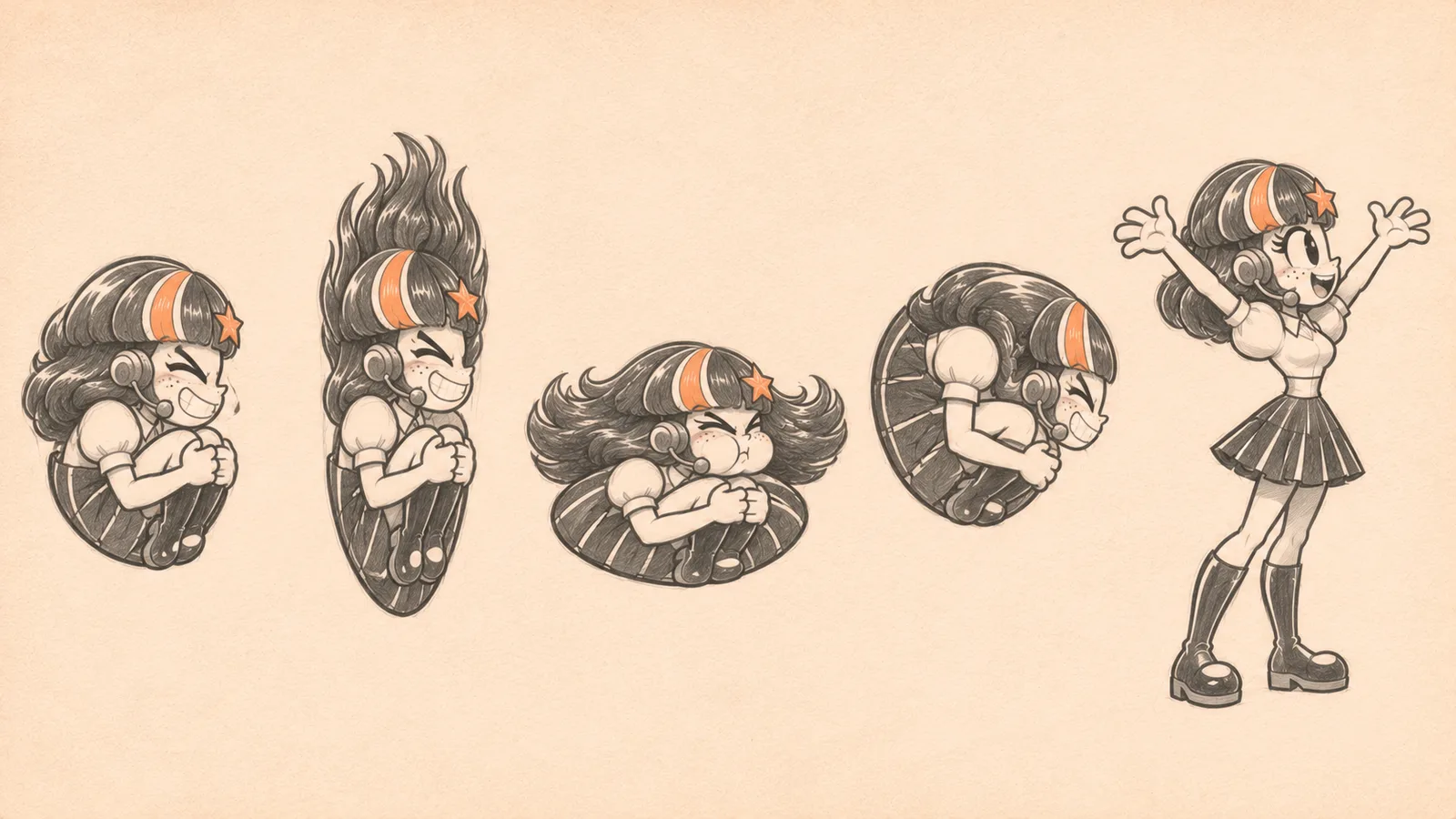
All but one of the explanatory demos star Claudia in pencil drawings made one at a time. Codex drew 13 sheets, 89 drawings in all. Claude cut, aligned and animated them.
89 drawings, 13 sheets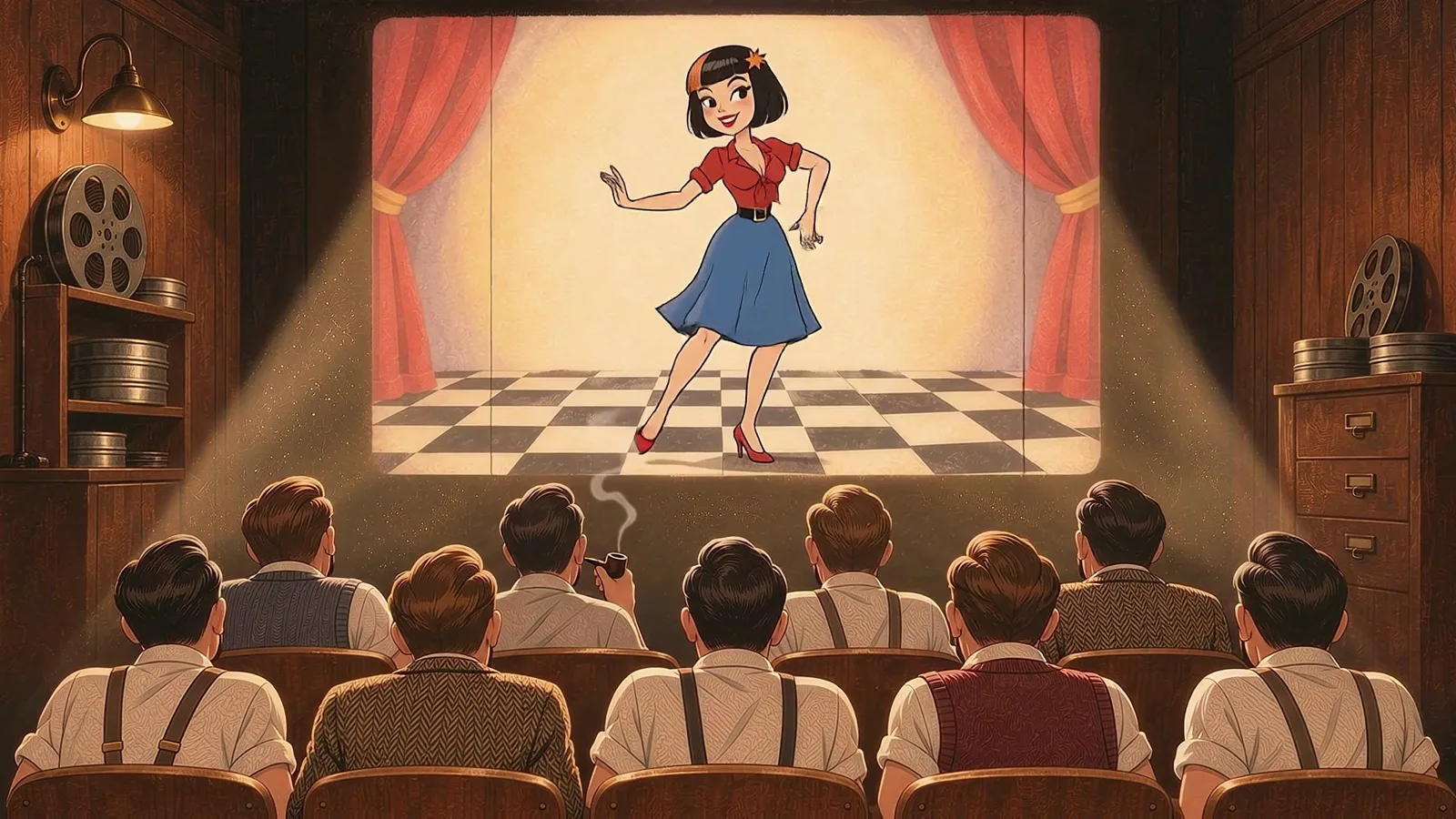
09
A screening room with nine animators seen from behind, generic, with no real person named or portrayed, and a 1960s genie number that comes out of a lamp and goes back in.
10
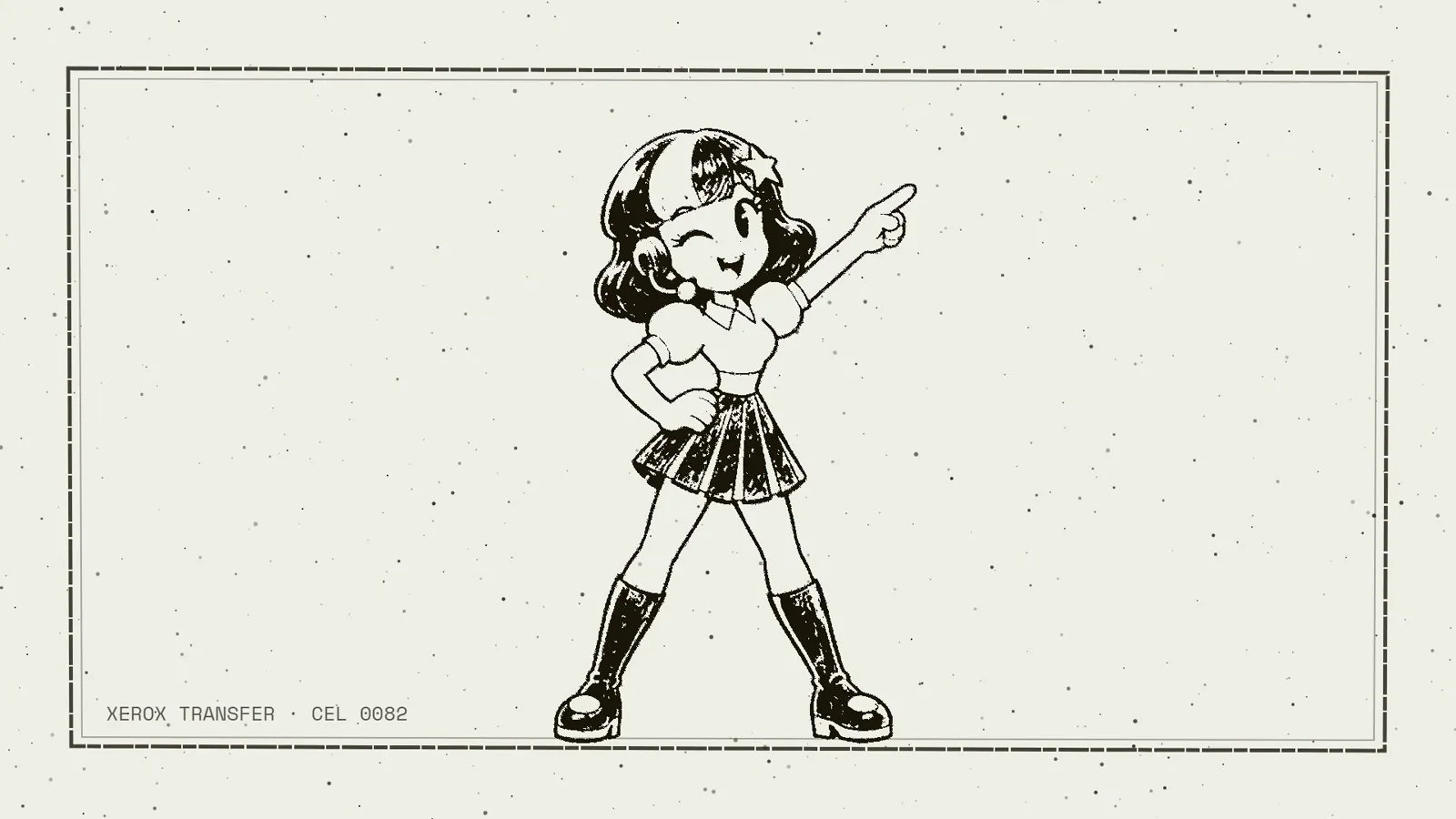
Claude split the polish among agents working in parallel. The counter appears only when she earns a principle, in each era’s lettering. The 23 page turns follow each era’s medium: paper, acetate, photocopy, scanner, render tiles, editor interface. The lyrics move in a different free typeface per era. One agent researched the fonts and another measured the contrast of every line. QA agents checked the render frame by frame.
the transition is the medium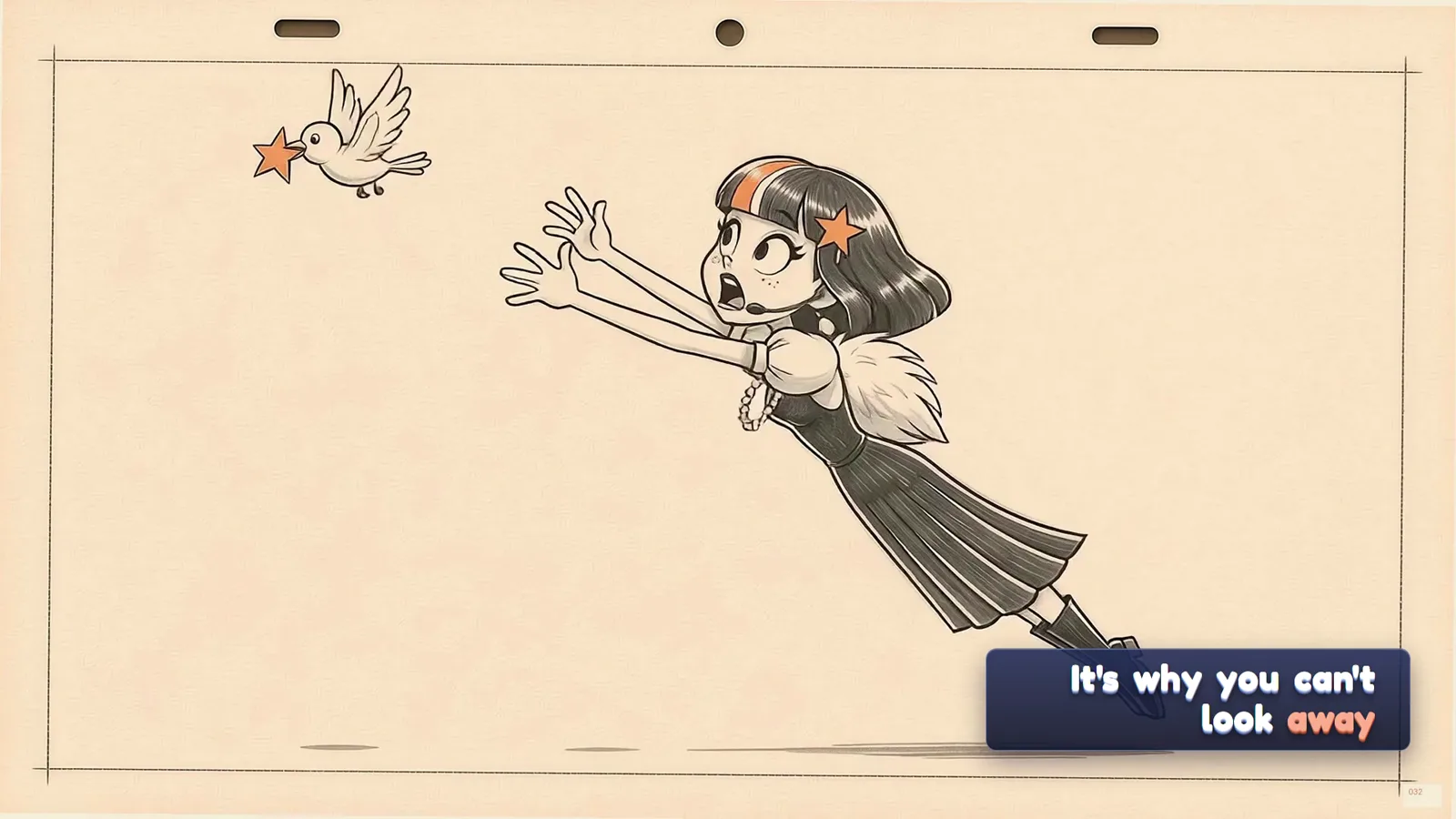
11
Everything is composed and rendered from code, so every version is exact and can be repeated.
Sc. 4 · Discoveries
The head turn was so fast the drawings disappeared. Holding each one twice as long is what made them visible.
Feeding each era the one before it kept her recognisable across a century of styles.
When the page turn is made of the era’s own medium, the edit explains how animation was manufactured.
Knowing where each safety filter sits is a production skill, not a hack.
The free fallback worked, and the better cut was still a trick from the old toolbox.
No video budget pushed every decision toward craft: reuse, timing, editing, drawing.
Sc. 5 · Retakes
Sc. 6 · Credits on the desk
| Juanhuman, director | The idea, the lyrics, every approval, every Flow and Grok run, Claudia’s 1990s look. |
|---|---|
| Claude Opus 5.5lead agent, in Claude Code | Concept and script with Juan, beat map, storyboard, Flow prompts, every animation in code, edit, mount, render. |
| Minaimage agent, ChatGPT | The character sheets of every era. |
| CodexOpenAI coding agent with image generation | First and last frames, the frame-by-frame sheets, colour credit cards, the curtain. |
| Solreview agent | Critiqued the concept, the 11/12 peak, naming, a site contrast audit. |
| Claude’s sub-agents19 tasks in parallel | Prompts, demos, QA, counter, page turns, lyric typography, font research, contrast audit. |
| Google Flowvideo model | The moving clips. |
| Grok, free tiervideo model | One genie shot, later cut from the film. |
| Sunomusic model | Music and voices. The lyrics are Juan’s. |
| HyperFramesHTML to video | Rendering the code-made animation. |
Sc. 7 · The receipt
Total: 1 Claudia, alive
$0 is the incremental cost of generating video, on Juan’s existing Google AI Pro credits and Grok’s free tier. It is not $0 of subscriptions, labour, tools or creative value.
The receipt inside the film lists 69 drawings, 24 clips and 17 demos. These are the later counts from the production log.
End
Original lyrics and direction: Juan.
Animated by Claude Opus 5.5. Character sheets: ChatGPT. Frames and frame-by-frame drawings: Codex. Moving clips: Google Flow. Music and voices: Suno.
Claudia is an open character by anabology (claudia.gallery).
The art, the motion and the music were made with AI tools, directed and approved shot by shot by a human. Typefaces are free fonts under OFL and Apache licences.
An independent, educational project. Not affiliated with Anthropic, OpenAI, Google or any animation studio, and it uses no studio imagery, logos or footage.